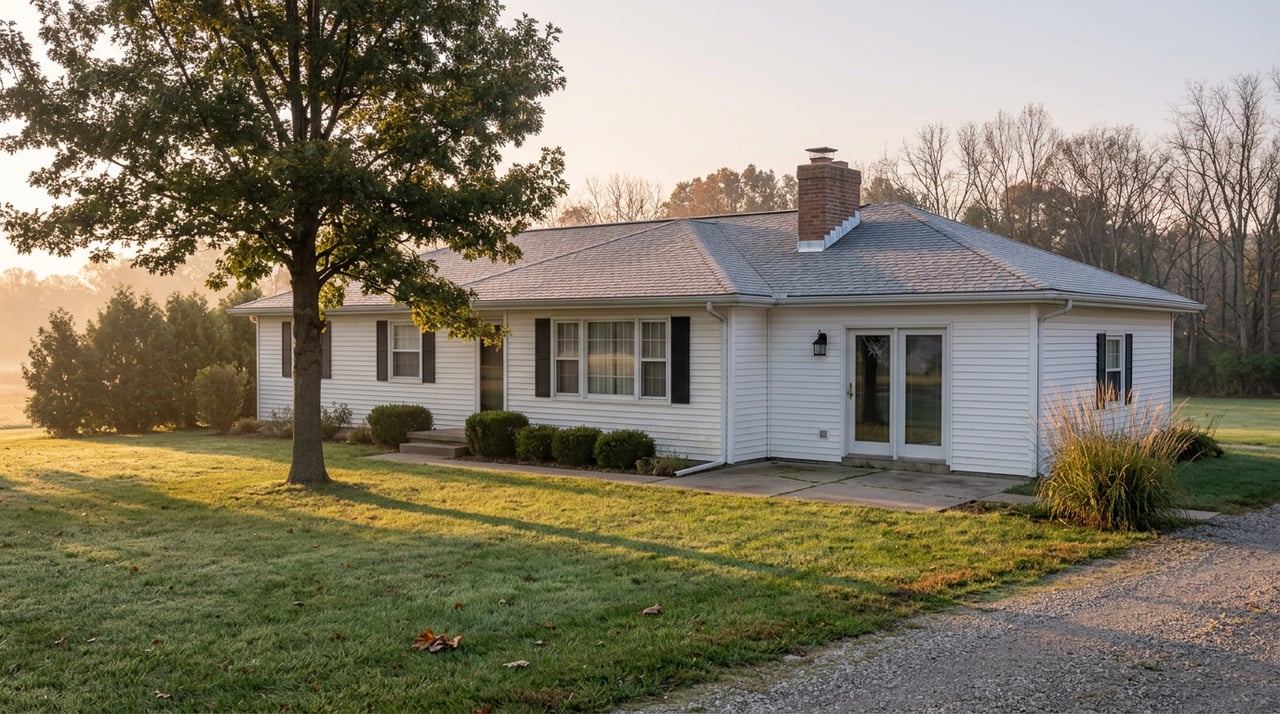
Allegan County Has No Septic Ordinance. Otsego Sellers Still Can't Skip The Inspection.
September 3, 2026
September 3, 2026
Ask Allegan County whether it requires a septic inspection before you sell your home in Otsego, and the honest answer is no. There is no ordinance on the books that stops a closing until a sanitarian signs off on your drain field. That puts Otsego in a different category than a growing list of Michigan counties, several of which have added exactly that kind of rule in just the last few years.
But sellers who read that as permission to skip the inspection are about to have an uncomfortable conversation with a lender, a buyer's agent, or their own purchase agreement. The rule that isn't a county ordinance shows up anyway, just later in the process and on someone else's schedule instead of yours.
Most purchase agreements for a home with a private well and septic system in Southwest Michigan attach a standard well and septic addendum. That form starts with a checkbox: is the property located in Macomb, Washtenaw, or Wayne County, where local regulations governing on-site sewage disposal and water supply evaluation are already in effect? If yes, the buyer and seller follow one set of steps built around that county's mandatory process. If no, which is Otsego's answer every time, they follow a different path where the inspection becomes something the buyer and seller negotiate rather than something the county requires.
In that second path, either the seller or the buyer agrees to pay for a well and septic evaluation from the county health department or a private inspection company, and the buyer gets four calendar days after receiving the report to reject the results and walk away with their earnest money back. There's also a second box on the same form: the buyer can waive the inspection entirely and take the well and septic system as-is. Nothing about Allegan County forces either outcome. The addendum simply hands the decision to whoever has more leverage in that specific negotiation.
Allegan County's Environmental Health division does perform evaluations of existing septic and well systems, but its own description of when that happens is worth reading closely. The county states that evaluations of existing systems happen usually at the request of a lending institution or a home buyer, not as an automatic step triggered by the transfer of a deed. That's a meaningfully different posture than counties running an actual point-of-sale program.
Compare it to what's happening elsewhere in the state right now.
| County | Septic/well evaluation required before sale | In effect since |
|---|---|---|
| Benzie | Yes, for every private well and septic system, no distance buffer | 1992 |
| Leelanau | Yes, under a unified code with Benzie County | January 2023 |
| Grand Traverse | Yes, but only for homes within 300 feet of surface water | January 1, 2026 |
| Washtenaw | Yes, under its own on-site sewage disposal regulations | Already in effect |
| Allegan | No county mandate. Evaluations happen at the request of a lender or buyer | Not applicable |
Michigan is the only state without a statewide sanitary code, which is exactly why this table looks the way it does. Each of the state's 45 local health departments writes its own rules, and Allegan simply chose not to write a mandatory transfer rule the way Benzie did more than three decades ago. That choice doesn't remove the inspection from your transaction. It just moves the decision about whether one happens from the county's rulebook into your purchase agreement and your lender's underwriting file.
If your buyer is financing with an FHA or VA loan, the lender will require proof the septic system functions properly and meets minimum distance requirements from the well before the loan closes, regardless of what Allegan County's ordinance does or doesn't say. Sellers who decline any inspection request often find they've quietly shrunk their buyer pool to cash offers and conventional loans only, because FHA and VA underwriting won't move forward without that proof.
This matters more in a market that isn't giving anyone much slack. Homes across Allegan County sold in about 11 days on average over the three months ending in May 2026, a pace that leaves little room to discover a septic problem mid-transaction and still hit your closing date. A drain field replacement runs $5,000 to $15,000 or more depending on soil conditions, and a tank replacement typically costs $3,000 to $7,000 installed. Either number is a real conversation to have at the negotiating table. Neither is a conversation you want your lender's underwriter to force on you during week three of a 30-day close.
Even with no Allegan County mandate, Michigan's Seller Disclosure Act still requires you to complete a Seller's Disclosure Statement before the buyer signs a purchase agreement. That form asks directly about the septic tank and drain field condition, the age of the well and pump, and any known problems or repair history. You're required to answer honestly based on what you actually know, and the law doesn't grade on a curve just because your county never built a formal transfer program.
Michigan case law backs that up. In Pilcher v. Benoit, the Michigan Court of Appeals took up a dispute over whether a seller committed silent fraud by not disclosing a faulty septic tank cover, a defect the buyer only discovered after closing when they fell over it in the backyard. The court found there was a genuine question of fact about what the seller knew at the time the disclosure statement was signed. No ordinance required an inspection in that case either. The disclosure law was doing all the work.
None of this applies the same way to every address in Otsego. The city itself runs its own wastewater treatment plant, originally built in 1954 and 1955 and expanded in 1989 and 1990, with capacity for 750,000 gallons of wastewater a day against a current load closer to 300,000 to 400,000 gallons. The city also maintains a mapped wellhead protection area around its municipal well field at Brookside Park. If your home sits inside city limits on municipal water and sewer, this entire conversation about wells and septic systems likely doesn't apply to your closing at all.
Otsego Township runs its own separate water and sewer utility with its own billing, so some developed parcels just outside the city line are also on municipal service. But the farther you get from the city and the developed township corridors, into the surrounding farmland and rural subdivisions that make up much of the broader Otsego area, private well and septic becomes the standard rather than the exception. That's exactly the geography where the addendum, the lender requirement, and the disclosure form all start to matter.
If you're preparing to sell a well and septic home in that outer ring, a few steps make the rest of this easier:
That kind of local familiarity matters here. Dentler Environmental Inspections, based nearby and serving Allegan, Barry, Kalamazoo, and Van Buren counties, is run by an Otsego High School graduate who spent nearly 20 years as an environmental health sanitarian at the Allegan County Health Department, 17 of those years as a state-licensed Registered Sanitarian. That's the kind of background that knows exactly what a county evaluator is looking for, because he used to be one.
Does Allegan County require a septic inspection to sell a home? No. There is no county-wide time-of-transfer ordinance. Evaluations happen when a lender or buyer requests one, not automatically.
If there's no county mandate, can I just skip the inspection? You can, if your buyer agrees to waive it under the addendum's second option and isn't financing with FHA or VA. Most buyers, and nearly every institutional lender, will still ask for one.
What if I genuinely don't know my last pump date? Say so on the disclosure form. Michigan's disclosure law is based on what you actually know, and marking "unknown" honestly is a legitimate answer. Guessing and being wrong later is what creates liability.
Does any of this apply if I'm inside Otsego's city limits? Almost certainly not, if your home is connected to the city's municipal water and sewer system rather than a private well and septic system.
A septic system doesn't announce itself on a listing photo, and a missing county ordinance doesn't mean a missing conversation. If you're weighing when to list a well and septic property in the Otsego area, or you just want a clear-eyed read on what your specific address requires before a lender or buyer forces the timing, Atwood Properties Group can walk through it with you. Get your instant home valuation and let's talk through what your property actually needs before it hits the market.
Stay up to date on the latest real estate trends.

Partner with Atwood Properties Group for expert guidance in buying, selling, renting, or investing. Honest advice, seamless service, and local expertise you can trust every step.