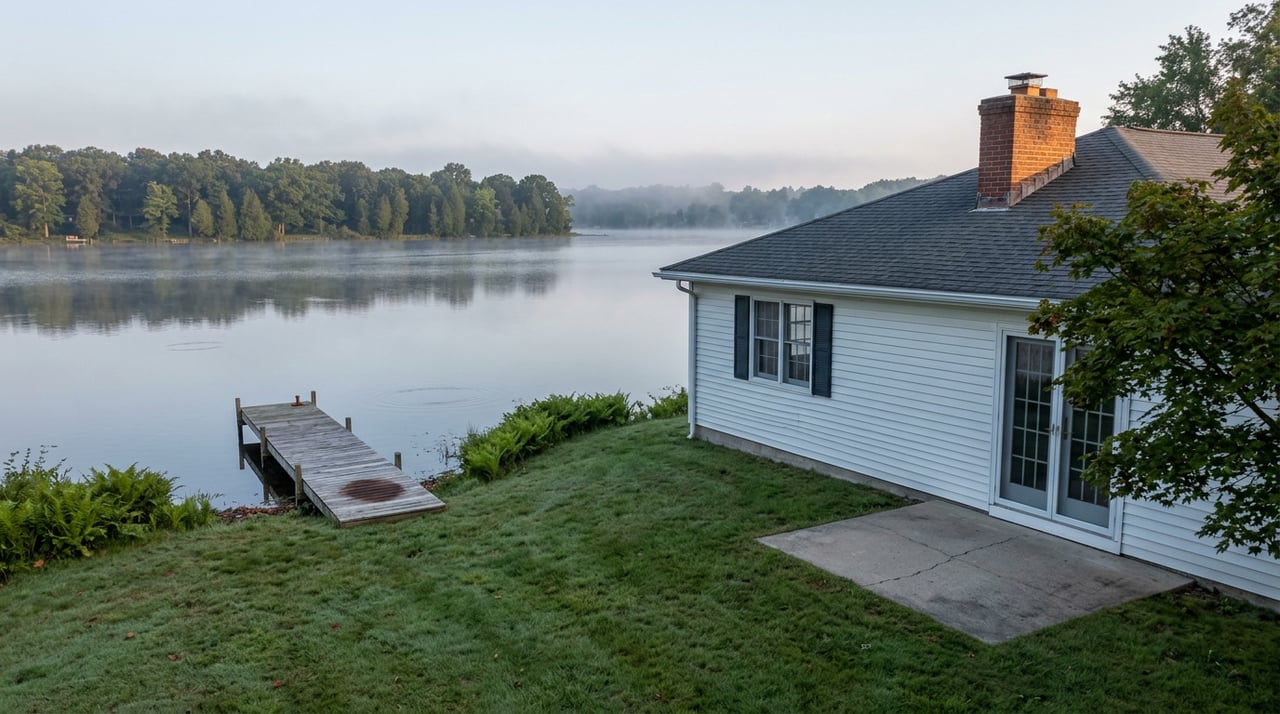
The Dam That Makes Lake Allegan a Lake Is Currently for Sale for One Dollar
September 17, 2026
September 17, 2026
A buyer who writes an offer on Lake Allegan waterfront this month could close on the property before Michigan regulators decide who will own the dam that holds the lake in place. That is not a hypothetical. Consumers Energy just pushed its decision timeline back another 60 days as of September 8, 2026, which means a ruling that was originally expected this month is now likely to land closer to November. A typical closing runs 30 to 45 days. Do the math and the two calendars overlap almost exactly.
Here is the number that makes this worth stopping on: the proposed sale price for the dam is one dollar. Not one dollar per square foot, not one dollar per acre-foot of reservoir. One dollar, full stop, for the entire structure that turns a stretch of the Kalamazoo River into the 1,600-acre lake that every waterfront listing in Allegan County is built around. Anyone shopping that shoreline right now is pricing a home against a lake whose long-term custodian is still an open question at the state level, not a settled fact the way the square footage or the lot line is.
Lake Allegan is not a natural lake. It exists because the City of Allegan built the Calkins Bridge Dam across the Kalamazoo River in the mid-1930s, and Consumers Energy took over the dam a few decades later as part of a broader purchase of the city's electric system. The lake has been there ever since, and every dock, seawall, and waterfront listing on it sits on a reservoir whose water level is a function of that dam's operation, not the weather.
Consumers now wants out. The utility is trying to sell all 13 of its Michigan hydroelectric dams, Calkins Bridge among them, to Confluence Hydro, a private equity-backed operator. The headline price is one dollar per dam. That number only makes sense once you understand what is actually changing hands. Consumers has told state regulators the dams generate roughly $13.3 million in revenue and cost about $13 million to operate, a thin margin on assets that need more than $1 billion in combined relicensing investment over the next several years. The Hardy Dam upgrade alone is projected above $350 million. The sale isn't really a purchase of income-producing infrastructure. It's a transfer of future liability, wrapped in a 30-year agreement where Consumers will keep buying power back from Confluence at roughly twice the normal hydroelectric rate to make the deal pencil out for the buyer.
That structure is why the Michigan Department of Natural Resources took the unusual step of formally opposing the sale, the first time in the agency's more than 100-year history it has intervened in a utility case. A coalition of conservation groups and anglers has raised similar objections, arguing the deal shields Consumers from decades of deferred maintenance costs while handing the risk to a buyer with a track record of acquiring and reselling dams elsewhere.
If the sale is approved, the dam stays in operation under new ownership, backed by a $270 million Hydro Safety Fund Consumers pledged in July 2026 to cover any long-term safety issues that surface after the handoff. Lake levels stay managed the way they have been for the better part of a century.
If the sale is rejected, Consumers has said its next-lowest-cost option is decommissioning: removing the dam structures and draining the reservoirs. The utility has been explicit that this would significantly change the waterfront areas that currently ring the lake. That is not a fringe scenario raised by opponents of the deal. It is the company's own stated fallback, on the record, if the deal it prefers does not go through.
A few residents have also pointed out that the dam does more than hold water back. It functions as a sediment trap for the Kalamazoo River and blocks sea lamprey, an invasive species, from moving further upstream. Removing it would not just lower the lake. It would change what happens downstream toward Saugatuck as well. That is part of why some lake residents who might otherwise distrust a private equity buyer have come around to supporting the sale as the less disruptive of the two paths on the table.
Here is how the process has actually unfolded, month by month:
| Date | What happened |
|---|---|
| November 2025 | Consumers Energy and Confluence Hydro held a town hall in Allegan for residents affected by the sale of Calkins Bridge Dam |
| April 2026 | State commissioners questioned executives at a hearing where the $1-per-dam price and the 30-year power purchase terms were disclosed |
| May 2026 | The Michigan DNR formally opposed the deal for the first time in its history, with the Michigan Public Service Commission review continuing |
| July 2026 | Consumers pledged a $270 million Hydro Safety Fund and confirmed decommissioning as its fallback if the sale is rejected |
| September 8, 2026 | Consumers voluntarily extended the regulatory decision timeline by 60 days to address remaining concerns |
None of this is speculation limited to environmental groups. The Lake Allegan Association, which represents the people who actually live on the lake, ran its own parcel-by-parcel tax analysis and put real numbers behind what a bad outcome would cost. By its accounting, frontage and backlot property around the lake carries a combined market value of roughly $124 million and generated about $2 million in property taxes as of 2022, a figure that accounted for 45 percent of Valley Township's entire tax revenue. The Association modeled a scenario where the dam's future goes sideways: a 30 percent loss in frontage property value paired with a more modest 10 percent loss on backlot parcels. Their own math puts the resulting hit at more than $500,000 in lost annual tax revenue, with roughly $338,000 of that coming out of local school funding.
That is a homeowners' association putting a dollar figure on the downside case, not an outside critic. It tells you the stakes here are not abstract. They are large enough that the people with the most to lose have already done the spreadsheet work most buyers have not.
The pitch you will hear about Lake Allegan is that it is undervalued relative to Saugatuck and Holland because much of its shoreline sits inside the Allegan State Game Area, state land that blocks new private development along large stretches of the lake. That keeps active waterfront listings scarce, often in the single digits at any given time, and it is a genuinely appealing feature for anyone tired of watching other Michigan lakes get built out.
That scarcity argument and the dam ownership question are two separate conversations, and only one of them is settled. State game land protects the shoreline from condos. It does nothing to resolve who owns the dam controlling the water level in front of that shoreline, or what happens to the reservoir if that ownership question gets answered the wrong way. A buyer weighing the lake's supply constraints against its price should also be weighing the fact that the entity determining whether there is a lake to build a dock on at all is currently the subject of an active state regulatory filing.
Ask when the Michigan Public Service Commission expects to rule, and compare that date against your anticipated closing date. Given the September 8 extension, a decision landing sometime around early November 2026 is a reasonable expectation, though regulators have not committed to a firm date and further delay is possible.
Ask your lender and insurer whether the pending ownership transfer factors into their underwriting on a waterfront file, separate from the standard flood zone and dock coverage questions that come with any lake property. Lakefront homes typically carry insurance and financing considerations that inland homes do not, and an active ownership dispute over the dam is a variable worth naming out loud rather than assuming someone else has already flagged it.
Ask the seller or listing agent whether they can point you to the property's history with any past high-water or low-water events, since the dam's operator sets the reservoir level and that has been true for the better part of a century regardless of who signs the paperwork next.
Is Lake Allegan a natural lake? No. It formed when the City of Allegan built the Calkins Bridge Dam across the Kalamazoo River in the mid-1930s. Everything about the lake's water level has depended on that structure ever since.
When will the Michigan Public Service Commission decide on the dam sale? A decision was originally expected around September 2026. Consumers Energy voluntarily extended that timeline by 60 days as of September 8, 2026, pushing a likely ruling toward early November, though no date is guaranteed.
What happens if the sale to Confluence Hydro is rejected? Consumers Energy has stated its fallback is decommissioning the dam, which would include removing the structure and draining the reservoir, a process the utility itself describes as significantly changing the surrounding waterfront.
Does the surrounding state game land protect the lake itself? It protects the shoreline from new private development. It has no bearing on who owns the dam or what happens to the water level, which is being decided through a separate state and federal regulatory process.
If you are weighing a purchase on Lake Allegan or wondering what any of this means for a property you already own there, we are following this process closely and are glad to walk through the timeline with you. Reach out to Atwood Properties Group or get your instant home valuation to start the conversation.
Stay up to date on the latest real estate trends.


Partner with Atwood Properties Group for expert guidance in buying, selling, renting, or investing. Honest advice, seamless service, and local expertise you can trust every step.